Microgrid-Enabled Charging Systems Power Europe’s Energy Transition
2026–Across Europe, microgrid energy storage charging systems are moving from pilot projects to commercial deployment, delivering measurable results in grid optimisation and cost reduction.
In Regensburg, Germany, a field test conducted from April to May 2026 demonstrated how battery-buffered microgrid technology unlocks fast-charging capacity where grid connections fall short. The site operates on a 125 kW grid connection yet delivers up to 300 kW charging power via an integrated 201 kWh battery storage system. Operating costs were reduced by several thousand euros per year through peak shaving and optimised energy procurement.
EU-backed initiatives are accelerating deployment. The HELIONS project, with €1,069,607 in EU funding, brings together 11 partners across Norway, Belgium, Greece, and France to develop high-power hybrid battery storage platforms. The HYBRIS project, involving partners from France, Belgium, Italy, and Spain, focuses on hybrid battery systems for grid services.
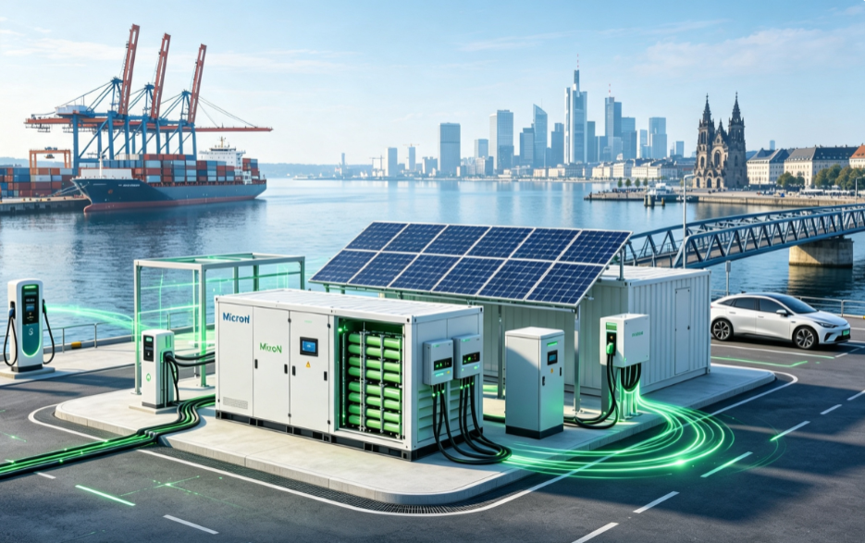
Port infrastructure is a key application area. The enerPort II project at Duisburg Gateway Terminal—Europe‘s largest inland port—integrates 1.3 MWp solar PV, 1.5 MW battery storage, and hydrogen fuel cells in a terminal microgrid. The €4.7 million Port of Stockholm microgrid project, running through November 2027, combines PV and battery storage to enable shore power without grid upgrades.
As EU regulations mandate shore power for all container and passenger vessels by 2030, and with European energy storage installations having grown 45% year-on-year to 27.1 GWh in 2025- a momentum that continues into 2026, microgrid-enabled charging systems—powered by advanced power conversion technology—are poised to become the backbone of Europe’s sustainable transport infrastructure.
At Intersolar Europe 2026 (June 23–25), industry showcased modular power conversion as the enabling technology for these systems. This is where our products come in: Maxwell’s comprehensive range of AC-DC, bidirectional AC-DC, DC-DC, and bidirectional DC-DC modules serves as the core building blocks for microgrid charging infrastructure. Supporting voltages up to 1500 VDC and 2000 VDC, and available in both air-cooled and liquid-cooled variants, our modules deliver the scalability, efficiency, and environmental resilience that European ports, charging operators, and system integrators require.
-
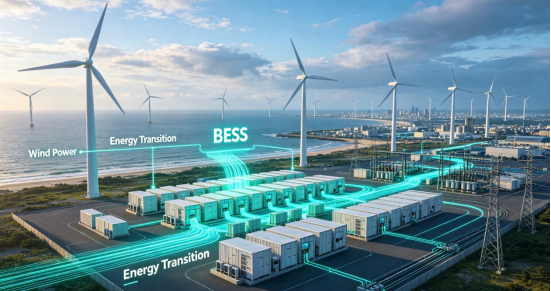
Chile’s 2026 BESS Acceleration: Optimizing the Grid with Advanced DC-DC Topology
Chile’s 2026 BESS market is accelerating as solar curtailment and grid modernization drive demand for high-efficiency energy storage. This article explores how DC-coupled BESS architectures and bidirectional DC-DC converters can improve energy utilization in Chile’s solar-rich regions, with Maxwell’s MXC100063B 62.5kW converter supporting modular energy storage applications.
넶17 2026-09-22 -
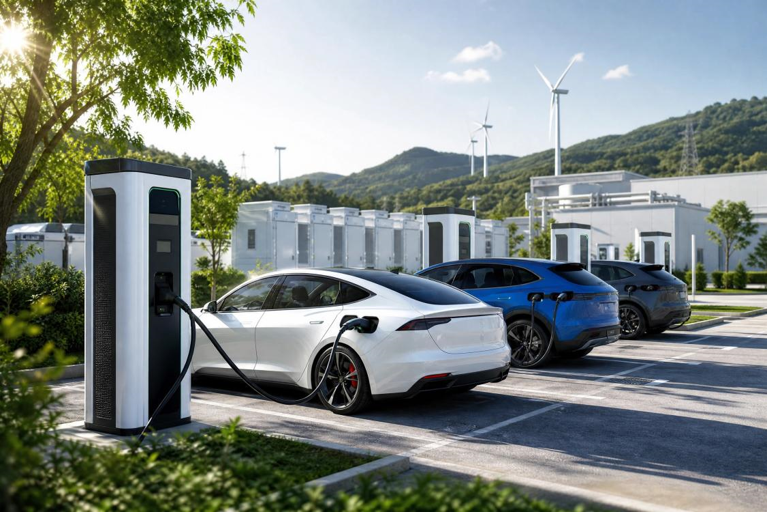
More Power, Less Space: How 120 W/in³ High Power Density Is Advancing Power Conversion
Explore how 120 W/in³ high power density is advancing power conversion for EV charging, energy storage, renewable energy, and other high-power applications. Learn how a compact 120 kW DC power module can help system designers optimize cabinet space, improve thermal management, simplify system architecture, and achieve greater power within a limited footprint.
넶14 2026-09-10 -
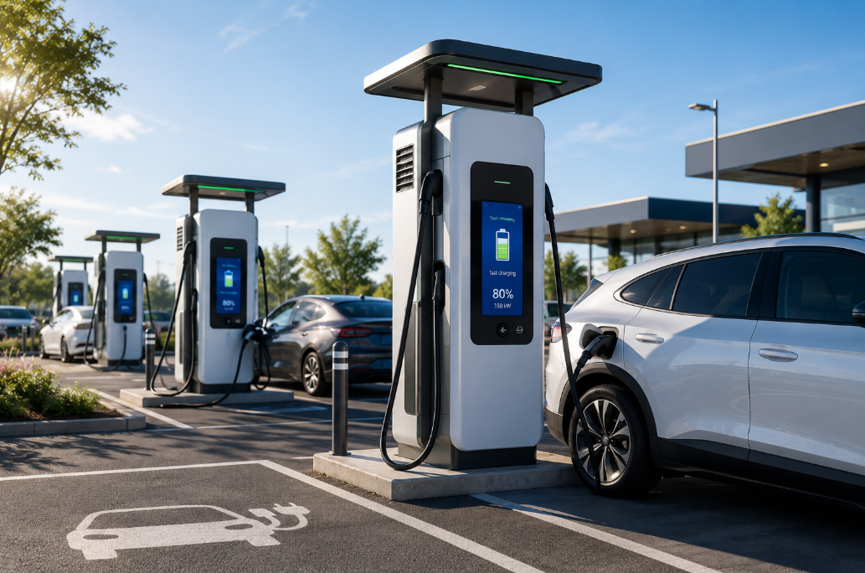
Texas Accelerates EV Charging Infrastructure Development and Demand for Advanced Charging Modules
Texas is accelerating EV charging infrastructure development as EV adoption continues to grow. The expansion of fast-charging networks is increasing demand for high-power, efficient, and reliable charging modules. Maxwell provides advanced AC-DC power modules designed to support scalable and high-performance DC fast charging systems.
넶23 2026-09-03